
Sunday, March 23, 2008


Saturday, March 22, 2008
the biggest hole on the earth surface
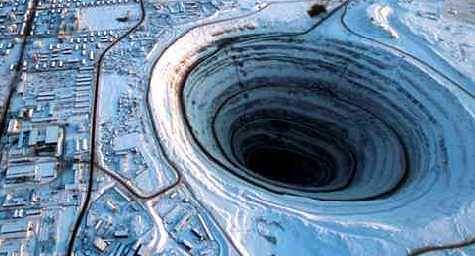
 Meanwhile, something altogether different and Jules Vernian is about to occur thanks to some Japanese scientists hoping to drill down into the earth's mantle: "Using a giant drill ship launched [in July 2005], the researchers aim to be the first to punch a hole through the rocky crust that covers our planet and to reach the mantle below."
 And then, in an oddly Borgesian, or perhaps MC Escherian, moment of nomenclatural mise-en-abîme, "The 57,500-tonne drill ship Chikyu (Japanese for Earth) is being prepared in the southern port of Nagasaki. Two-thirds the length of the Titanic, it is fitted with technology borrowed from the oil industry that will allow it to bore through 7,000 metres of crust below the seabed while floating in 2,500 metres of water – requiring a drill pipe 25 times the height of the Empire State building."
For some sense of perspective here, the diamond mine, pictured above, is 1200 meters deep; that means that to reach the mantle, the Japanese will have to produce a drill-hole nearly seven times deeper than the mine (which sounds alarmingly easy, actually – I was expecting to be horrified).
In any case, the drill-ship is called *Earth* and it's being drilled down into the earth... The attack of the simulacra begins.
[Note: This post originally stated that the mine was in South Africa – but I've corrected myself thanks to the comment, below. And apologize. It is, in fact, in Russia, as this BBC slideshow – which I actually looked at a few days ago without noticing (uh...) – makes clear. This BBC link also inverts the figures I had, so who knows: I had 1200m deep and 500m wide (which I suppose is a bit unlikely); the Beeb says the opposite. If that is the case, however, then that Japanese bore-hole into the earth's mantle will actually be at least *fourteen times* deeper than the Mirny mine...]
devis fall : attraction of pokhara
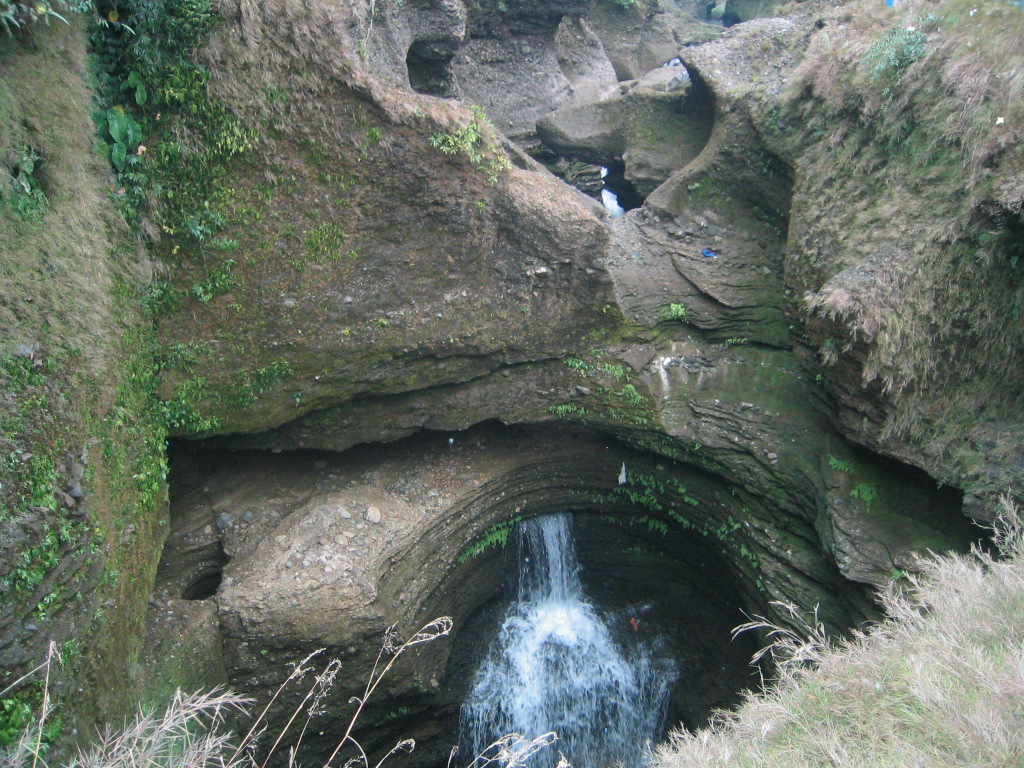
Devis Fall (Patale Chhango)
The water flowing from Phewa Lake shows a wonderful fall. We find hollow sandy part
and a heavy fall of water within its natural trench. It looks really amazing scene of
rainbow with sunlight when a volume of water falls in the deep rocky gorge and produces the water vapour especially in summer. Gupteshwar Mahadev cave is just opposite sides of Davi’s Fall where the Hindu religion people worship a temple of their great god Mahadev inside the cave and it is cave is almost 3 km long. This cave holds special value for Hindus since a phallic symbol of Lord Shiva is preserved here in the condition it was discovered. Cave has the connection
with the Davis fall gorge. It is quite interesting for exploration; it has some big hall-size rooms and some passages where you have to crawl on all fours.
Wednesday, March 19, 2008
The Wonder of the world : TAJ-MAHAL

Taj Mahal is regarded as one of the eight wonders of the world, and some Western historians have noted that its architectural beauty has never been surpassed. The Taj is the most beautiful monument built by the Mughals, the Muslim rulers of India. Taj Mahal is built entirely of white marble. Its stunning architectural beauty is beyond adequate description, particularly at dawn and sunset. The Taj seems to glow in the light of the full moon. On a foggy morning, the visitors experience the Taj as if suspended when viewed from across the Jamuna river.
Taj Mahal was built by a Muslim, Emperor Shah Jahan (died 1666 C.E.) in the memory of his dear wife and queen Mumtaz Mahal at Agra, India. It is an "elegy in marble" or some say an expression of a "dream." Taj Mahal (meaning Crown Palace) is a Mausoleum that houses the grave of queen Mumtaz Mahal at the lower chamber. The grave of Shah Jahan was added to it later. The queen’s real name was Arjumand Banu. In the tradition of the Mughals, important ladies of the royal family were given another name at their marriage or at some other significant event in their lives, and that new name was commonly used by the public. Shah Jahan's real name was Shahab-ud-din, and he was known as Prince Khurram before ascending to the throne in 1628.
Taj Mahal was constructed over a period of twenty-two years, employing twenty thousand workers. It was completed in 1648 C.E. at a cost of 32 Million Rupees. The construction documents show that its master architect was Ustad ‘Isa, the renowned Islamic architect of his time. The documents contain names of those employed and the inventory of construction materials and their origin. Expert craftsmen from Delhi, Qannauj, Lahore, and Multan were employed. In addition, many renowned Muslim craftsmen from Baghdad, Shiraz and Bukhara worked on many specialized tasks.
The Taj stands on a raised, square platform (186 x 186 feet) with its four corners truncated, forming an unequal octagon. The architectural design uses the interlocking arabesque concept, in which each element stands on its own and perfectly integrates with the main structure. It uses the principles of self-replicating geometry and a symmetry of architectural elements.
Its central dome is fifty-eight feet in diameter and rises to a height of 213 feet. It is flanked by four subsidiary domed chambers. The four graceful, slender minarets are 162.5 feet each. The entire mausoleum (inside as well as outside) is decorated with inlaid design of flowers and calligraphy using precious gems such as agate and jasper. The main archways, chiseled with passages from the Holy Qur’an and the bold scroll work of flowery pattern, give a captivating charm to its beauty. The central domed chamber and four adjoining chambers include many walls and panels of Islamic decoration.
The mausoleum is a part of a vast complex comprising of a main gateway, an elaborate garden, a mosque (to the left), a guest house (to the right), and several other palatial buildings. The Taj is at the farthest end of this complex, with the river Jamuna behind it. The large garden contains four reflecting pools dividing it at the center. Each of these four sections is further subdivided into four sections and then each into yet another four sections. Like the Taj, the garden elements serve like Arabesque, standing on their own and also constituting the whole.
Its all about BUDDHA and LUMBINI, NEPAL

History
Lumbini is the traditional birthplace of Gautama Buddha, the founder of Buddhism, who was born in the 7th or 6th century BC.
According to Buddhist tradition, Maya Devi (or Mayadevi) gave birth to the Buddha on her way to her parent's home in Devadaha in the month of May in the year 642 BC. Feeling the onset of labor pains, she grabbed hold of the branches of a shade tree and gave birth to Siddharta Gautama, the future Buddha. The Buddha is said to have announced, "This is my final rebirth" as he entered the world. Buddhist tradition also has it that he walked immediately after his birth and took seven steps, under each of which a lotus flower bloomed.
In 249 BC, the Buddhist convert Emperor Ashoka visited Lumbini and constructed four stupas and a stone pillar. Ashoka's Pillar bears an inscription that translates as: "King Piyadasi (Ashoka), beloved of devas, in the 20 year of the coronation, himself made a royal visit, Buddha Sakyamuni having been born here, a stone railing was built and a stone pillar erected to the Bhagavan ["blessed one"] having been born here. Lumbini village was taxed reduced and entitled to the eight part (only)".
Monasteries and temples were built at Lumbini until the 9th century, but Buddhism declined in the area after the arrival of Islam and later Hinduism. All that remained was a sculpture, revered by local women as a fertility symbol. The garden of the Buddha's birth was lost for a thousand years.
The site was rediscovered in 1895, when a German archaeologist came upon Ashoka's Pillar, identified by its inscription. Records made by the Chinese pilgrim Fa Xian were also used in the process of identifying this religiously acclaimed site. Lumbini was designated a UNESCO World Heritage Site in 1997.
What to See
world tallest bridge in france: MILLAU VIADUCT

This Cable-Stayed Bridge Project is on schedule to be completed January 2005. (39 month construction contract). This project is being financed privately. This project has the highest bridge piers in world. Thus the title of the Highest Bridge in the World. The tallest will be 240 meters high. Overall height an outstanding 336.4 meters. This project will consist of seven separate cable-stays.
--------------------------------------------------------------------------------
Bridges are often considered to belong to the engineer's realm rather than the architect's. But the architecture of infrastructure has a powerful impact on the environment. The Millau Viaduct, designed in collaboration with engineers, illustrates how the architect can play an integral role in bridge design.
Located in southern France, the bridge will connect the motorway from Paris to Barcelona at the point where it is interrupted by the River Tarn, which runs through a wide gorge between two plateaus. A reading of the topography suggested two possible approaches: to cross the river, the geological generator of the landscape; or there was the challenge of spanning the 2.5 kilometers from one plateau to the other in the most economical manner.
The structural solution follows from the latter philosophical standpoint. The bridge has the optimum span between cable-stayed columns. It is delicate, transparent, and uses the minimum material, which makes it less costly to construct. Each of its sections spans 350 meters and its columns range in height from 75 meters to 235 meters - higher than the Eiffel Tower - with the masts rising a further 90 meters above the road deck. To accommodate the expansion and contraction of the concrete deck, each column splits into two thinner, more flexible columns below the roadway, forming an A-frame above deck level. This structure creates a dramatic silhouette - and crucially it makes the minimum intervention in the landscape.
Construction Date: 2001
Completion Date: 2005
Statistics: Length: 2.5 km
Height: 280 m
Subscribe to:
Posts (Atom)